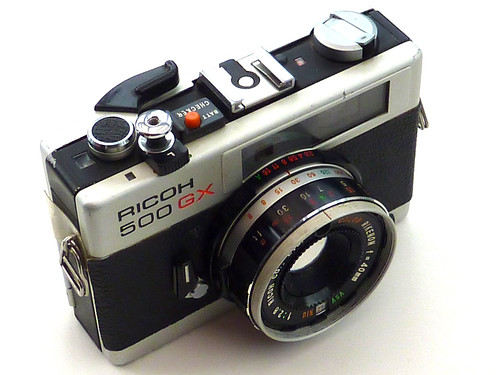
I picked this up in a charity shop a few weeks ago, can't remember exactly what the price was, but definitely less than £5.
It's well used, and the exposure meter is dead (I've tried it with various batteries, including brand new ones, but I gather from what I've read online that meter failure is common) but otherwise it works fine.
The shutter speeds go down to 1/8th, and there is a coupled rangefinder, but unusually for this class of camera, it has a double (or in fact multiple) exposure function. The shutter can be re-cocked without winding on the film, using a small slider on the front of the camera.
I've loaded it with ISO 400 colour negative film.
Saturday, 28 May 2011

Thursday, 26 May 2011
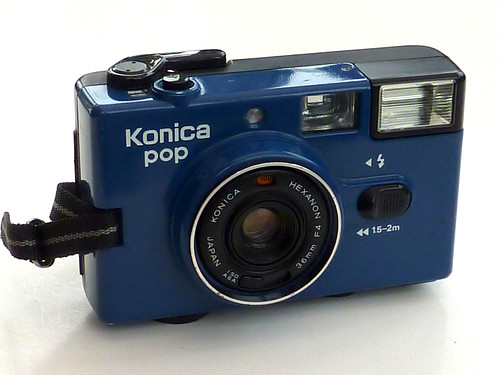
new acquisition - Konica Pop
This cheerful little camera is a little the worse for wear, but still works. It has a single shutter speed, and an aperture which is altered according to the film speed set and whether the flash is in use. There are no f numbers other than the f4 marked on the front, but I think apertures of around f4, f5.6, f8 and f11 are possible. It was £2.50 in a bootsale, and goes nicely with the non-functioning green version I picked up last year.
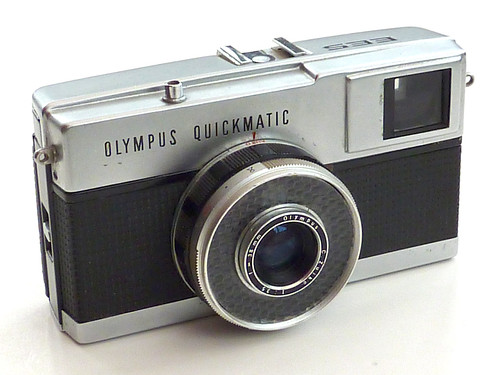
new arrival - Olympus Quickmatic
I got this on ebay for less than £5, it is the 126 cartridge version of the popular Olympus Trip which sold in its millions in the 1970s. It seems to work, though I think the automatic exposure system is inconsistent. I'll use it at some point, not sure how soon though.
Sunday, 22 May 2011
photo from week 72 - Coronet 3D
Although this camera is basically two identical simple cameras built into one, there is obviously a difference between the two. Despite some "correction" in Photoshop, there is still a visible difference between the sharpness and contrast between the two images.
I do remember reading that some stereo cameras (Wray Stereographic??) had their lenses set to slightly different focus points, to the eye/brain would see the stereo, but the sharpness would be OK for both near and far objects. I don't think this camera is that sophisticated!

I do remember reading that some stereo cameras (Wray Stereographic??) had their lenses set to slightly different focus points, to the eye/brain would see the stereo, but the sharpness would be OK for both near and far objects. I don't think this camera is that sophisticated!
photo from week 72 - Coronet 3D
This is a scan of the double frame as it comes out of the camera. I find it very difficult to see stereo pairs without using a viewer, the "freeviewing" techniques only work occasionally for me. As it stands, this should be viewed using the "cross-eye" technique.

Saturday, 21 May 2011
Week 73 - Pentina M
This week it was third time lucky when it came to selecting my camera. The first two had problems (hopefully solvable) so the Pentina has been drafted in at the last minute.
I've been putting off using this camera as it has no strap, and the lugs for attaching a strap do not work with any of the various straps I've got. I spent an inordinate amount of time cobbling together a way to attach a strap, but it seems to work.
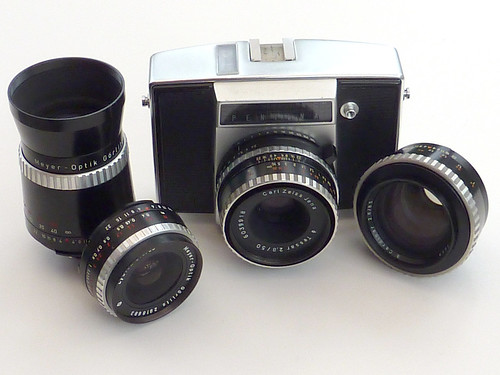
The camera was made in East Germany between 1963 and 1964, it has a leaf shutter and interchangeable lenses using its own proprietary bayonet mount.
The lenses are 30mm, 50mm, 85mm and 135mm.
I'm going to put a roll of Poundland Kodak ColorPlus in it.
I've been putting off using this camera as it has no strap, and the lugs for attaching a strap do not work with any of the various straps I've got. I spent an inordinate amount of time cobbling together a way to attach a strap, but it seems to work.
The camera was made in East Germany between 1963 and 1964, it has a leaf shutter and interchangeable lenses using its own proprietary bayonet mount.
The lenses are 30mm, 50mm, 85mm and 135mm.
I'm going to put a roll of Poundland Kodak ColorPlus in it.
Friday, 20 May 2011
Subscribe to:
Posts (Atom)